AIM's Springfield Report Card:
What Passed, What Failed, and What Quietly Died

The Illinois General Assembly has officially adjourned.
If you didn't follow every minute of the final weekend, don't worry. Most lawmakers probably didn't either.
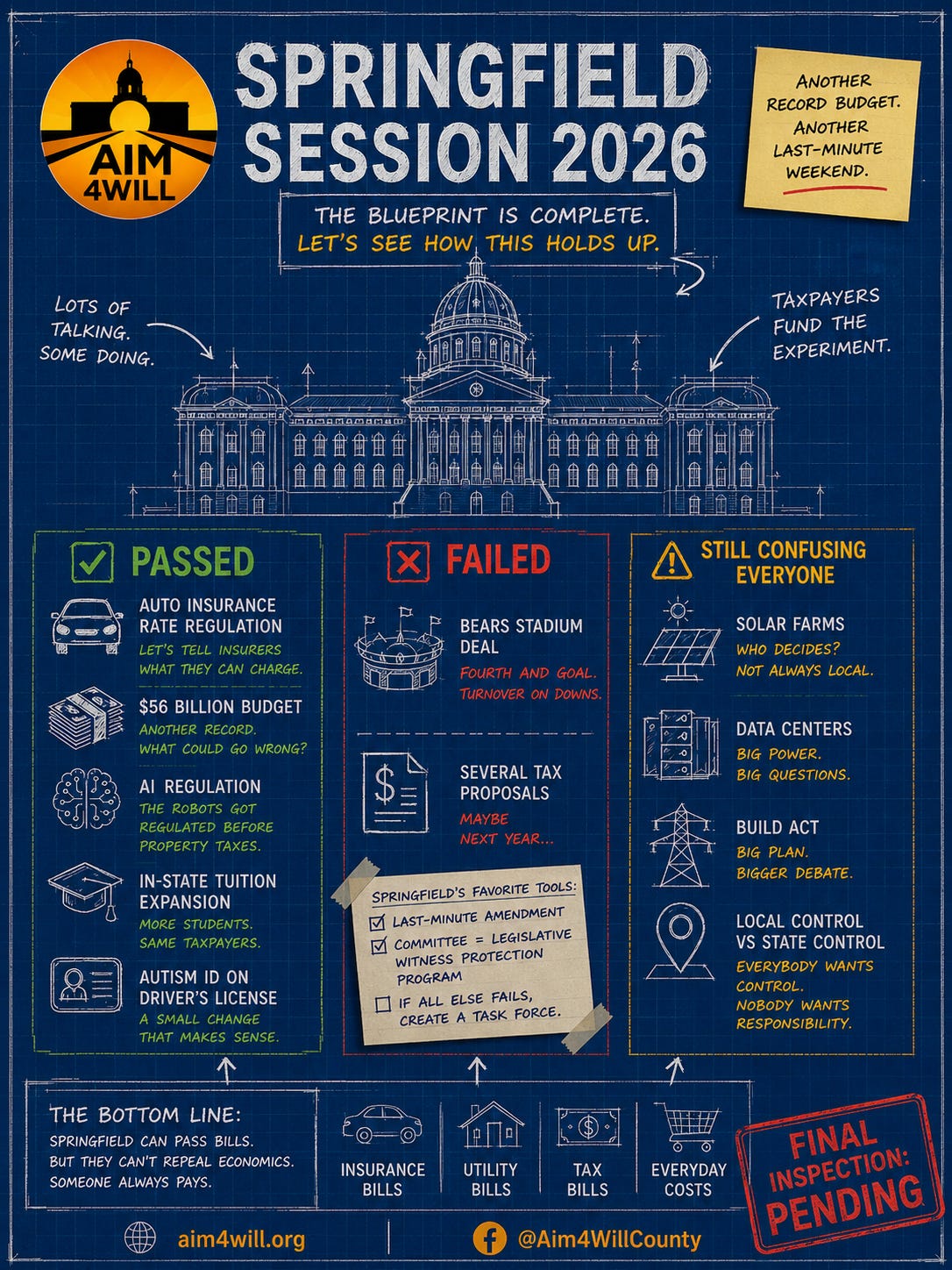
Here's your AIM recap.
✅ PASSED: Auto Insurance Rate Regulation
Springfield looked at rising insurance costs and essentially said:
"Have you considered not charging so much?"
The bill expands state oversight of auto insurance rates and gives regulators more authority over increases.
Supporters say it protects consumers.
Critics say it may lead to:
Higher deductibles
More claim denials
Fewer insurers willing to write policies
Companies becoming much pickier about who they insure
In other words, if you squeeze one side of the balloon, don't be surprised when the air pops out somewhere else.
✅ PASSED: Nearly $56 Billion Budget
Illinois passed another record budget.
At this point, Springfield budgets are like teenagers.
They eat more every year and somehow are still hungry.
The budget includes a variety of new taxes and fees while spending continues to climb.
The challenge isn't whether government provides important services.
The challenge is whether taxpayers can continue keeping up.
✅ PASSED: AI Regulation
Illinois lawmakers decided to regulate artificial intelligence.
To be fair, this may be the first time government has tried regulating technology before everyone was already mad about it.
The legislation includes new requirements involving disclosures, safety reviews, and consumer protections.
Illinois is positioning itself as one of the more aggressive AI-regulating states in the country.
✅ PASSED: Expanded In-State Tuition Eligibility
One of the more controversial bills of the session expands eligibility for in-state tuition rates at Illinois public universities to additional non-citizen students.
Supporters argue it improves educational access.
Opponents argue Illinois families are already struggling with tuition costs and should come first.
Expect this issue to remain politically active.
❌ FAILED: Bears Stadium Deal
After months of headlines, lobbying, negotiations, and speculation...
Nothing happened.
The stadium proposal never crossed the finish line before adjournment.
It's the legislative equivalent of driving to the goal line and running out of gas.
The Bears remain in limbo.
Taxpayers remain skeptical.
The conversation is far from over.
❌ FAILED: Numerous Tax and Revenue Ideas
Several proposals discussed throughout session never gained enough support to advance.
Some were quietly abandoned.
Others simply ran out of time.
This is Springfield's version of cleaning out the garage:
"Maybe we'll get to it next year."
☠️ DIED WITHOUT A FLOOR VOTE:
The Bills Nobody Wanted to Defend
Many controversial ideas never even made it to final debate.
Why?
Because sometimes lawmakers don't want to vote "yes."
Sometimes they don't want to vote "no."
And sometimes they don't want their name anywhere near the issue.
So the bill quietly remains in committee until everyone goes home.
Springfield's version of putting something in the freezer and pretending it isn't there.
⚡ THE BIGGEST NON-STORY:
Solar Farms, Data Centers, and Local Control
For much of the year, residents packed meetings and raised concerns about:
Solar developments
Data centers
Transmission lines
Local zoning authority
Yet despite all the discussion, there was no dramatic end-of-session showdown.
The debate continues because the underlying questions remain unresolved:
How much local control should communities have?
How much authority should Springfield have?
And who gets stuck paying for the infrastructure?
Expect this issue to return.
Probably sooner than later.
AIM'S FINAL GRADE
If Springfield were a homeowner, this session looked a little like:
✔ Bought new furniture
✔ Added a room
✔ Installed smart technology
✔ Took out another loan
❓ Promised everything will somehow cost less
The real test won't be what happened during the final 72 hours.
The real test will be what Illinois families see in their insurance bills, utility bills, tax bills, and housing costs over the next few years.
Because eventually every policy leaves committee and arrives in someone's mailbox.